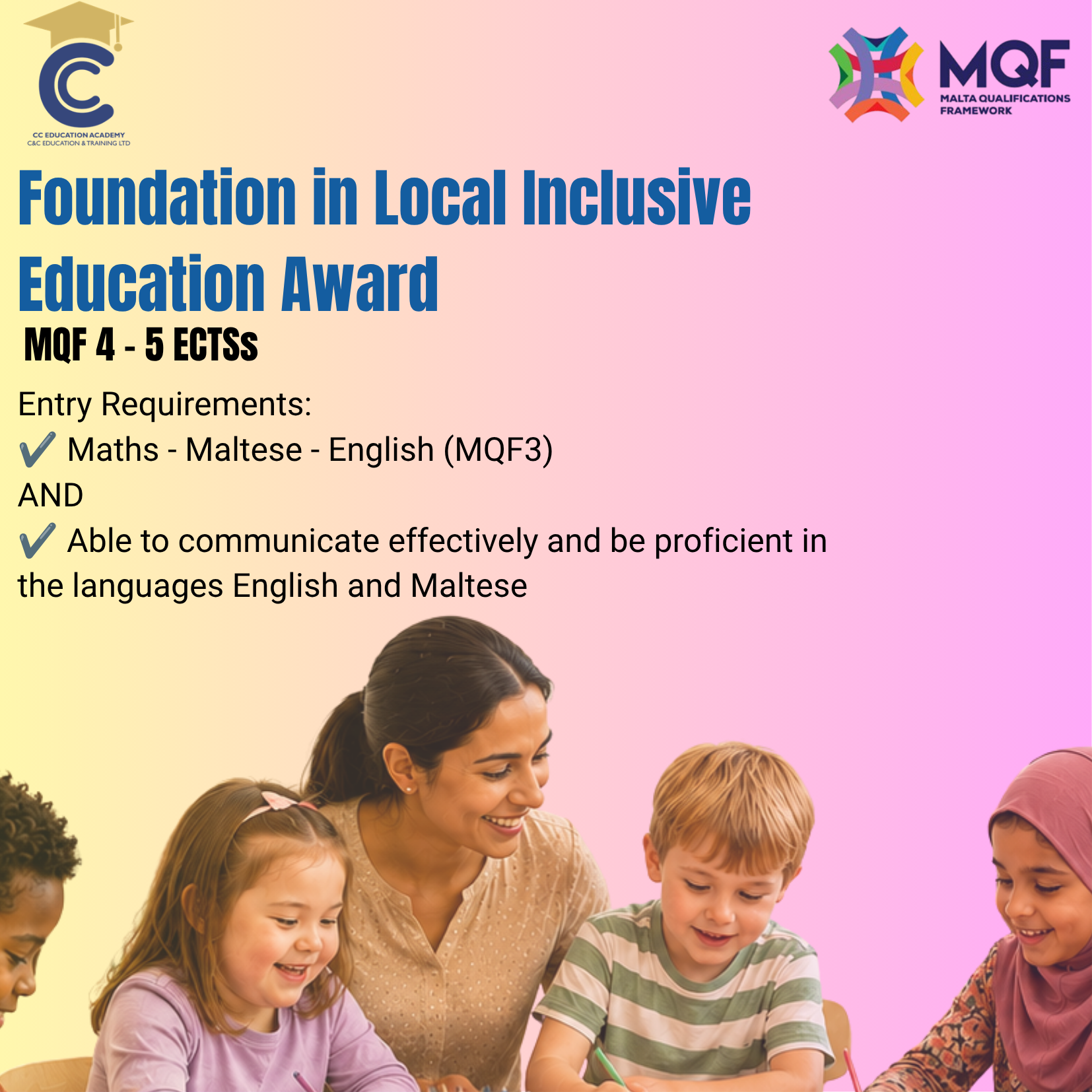
Foundation in Local Inclusive Education Award
CC Education Academy
Licensed as a Further and Higher Education Institution by the MFHEA
Licence no. 2022-019
Course delivery: ONLINE
Course duration: 5 weeks on a part-time basis
Language of Delivery: English/ Maltese
Total Hours (which includes self-study and assessment hours calculated according to the MFHEA guidelines) – 125hrs
Target Audience
The programme is for students who are interested in working as LSEs in Malta.
Entry Requirements
Learners must be able to communicate effectively and be proficient in the languages English and Maltese. Learners are required to be in possession of IELTS or equivalent as well as a minimum of three (3) qualifications at MATSEC level (MQF3), inclusive of Maltese, English, Mathematics and any other subject. Third country nationals should take note of the VISA requirement in the link: https://www.identitymalta.com/unit/central-visa unit/;
Grading
Learners must achieve a minimum score of 50% in each module to qualify for certification.
Student Success Rate
Up to date (March 2025), a 100% student success rate has been recorded. All students who have pursued this programme to the end have received their certification.
Entry requirements
Learners must be able to communicate effectively and be proficient in the languages English and/ or Maltese. Learners are required to be in possession of a minimum of three (4) qualifications at MATSEC level inclusive of Maltese, English, Mathematics and any other subject. There is no need for participants to be employed as educators, since this course does not have a teaching practice placement.
Refunds
Please note that all deposits are non refundable. Please make sure you are eligible and willing to participate before applying.
Modules
This module gives an overview of the major policies and how they should be upheld in schools.
Assessment method: 100% class participation that includes a discussion of pre-given reading and case studies related to topic
Module Learning Outcomes:
At the end of the module/unit the learner will have acquired the responsibility and autonomy to:
Acting ethically and following the directions of the policies
Implement the actions written in the policies, to make sure that they know what needs to be done to provide a just service to the student.
Identify the ways on how collaboration with colleagues and parents will provide a more inclusive education.
Define the purpose of all the aforementioned policies
Define the aims and content of the policies
Recall the main targets of the policies
Define the principles of inclusion, as listed in the inclusion policy
Identify ways on how to create a safe place for the students
Identify the importance of proper conduct at schools and foresee
different consequences of misconduct by analysing different scenarios.
Developing ways and plan on how to enhance inclusivity within the class environment.
identify appropriate ways in line with the school policies whereby a situation can be handled, through discussions about case studies.
Policies are always being updated and amended to provide a better meaningful education for all. This module provides basic knowledge on the main policies which should be upheld in a school environment.
Assessment method: 40% class participation that includes a discussion of pre-given reading and 60% Observation task
Module Learning Outcomes:
The module aims to introduce learners to the following files and
documents:
Student profile
Statementing Report and recommendations
Professional’s reports and recommendations
The IEP and MAP
Teacher’s scheme of work
Observation sheets
Daily schedules
Self-reflection
The aim of the introduction is for the learners to familiarise
themselves with the formal aspect of the duties of the LSE.
Create a student profile
Identify all the areas of an IEP, MAP and a student profile
Apply the recommendations suggested in the statementing and
professional reports
Define the importance of each document
List the different professionals that may participate in the formulation of the assessment
identify the purpose of the documents discussed
List the documents needed to be present in the student file
Devise a student profile
Use IEPs to gather information about the needs of the students
Compose an observation on a student using a video provided
identify the importance of the documents discussed
This module gives a better understanding on how to approach learning when students present with different disabilities. It emphasises the importance on focusing on the strengths to address the difficulties.
Assessment method: 40% class participation that includes a discussion of pre-given reading and case studies related to topic, and 60% - writeup
Module Learning Outcomes:
At the end of the module/unit the learner will have acquired the responsibility and autonomy to:
Create a plan of action for students with IEN
Create different resources in relation to different areas of need
Fill out observation sheets to identify different strengths and limitations
Name five different disabilities
Name the strengths and limitations of different disabilities
Define the different disabilities mentioned
Identify the needs according to developmental areas
Identify five strategies that can be used to address each developmental area
Apply their knowledge to create strategies relative to the needs
Prepare a plan on how to meet the needs of students for the 5
disabilities discussed
Look up different research to identify what can be done to meet the needs of the students
This module focuses on the meaning of inclusion and the role of the educators in enhancing the educational journey of the students.
Assessment method: 40% class participation that includes a discussion of pre-given reading, and 60% written task
Module Learning Outcomes:
At the end of the module/unit the learner will have acquired the responsibility and autonomy to:
Collaborate with other learners in discussing how to make a better classroom for all
Carry out tasks that ensure an inclusive environment
Comply with the ethical guidelines presented in the ‘Teachers’ code of Ethics’
Ensure that a classroom is inclusive by identifying any barriers
that a student might encounter when presented with case studies
List the various responsibilities linked to being a LSE
Define the importance of creating an inclusive environment
Define how diversity should be celebrated and not be seen as a barrier
Plan what can be done in schools so that diversity is celebrated
Apply their knowledge on inclusive education to create a more inclusive classroom
The interview is a one-to-one discussion with a tutor that consolidates what was learnt throughout the course. Through this discussion, the tutor guides the learners and ensures that they have acquired the knowledge.
Assessment method: 100% oral questions relating to the topics (mock interview) discussed throughout the course
Module Learning Outcomes:
At the end of the module/unit the learner will have acquired the
responsibility and autonomy to:
Show understanding of the meaning of inclusion, and how such principle can be encouraged and aided by the support of a LSE
Show appropriate interpersonal and intrapersonal skills during a meeting in a formal setting.
Show understanding on the importance of good inter/intrapersonal skills in informal settings
The importance of other adults when caring for the child
Identify the different personal qualities that make them a good fit for the role
Define verbal and nonverbal communication, and how to maintain a professional attitude throughout the communication.
Apply their knowledge to participate in a verbal discussion
Demonstrate good inter/intrapersonal skills in an official setting
Share their knowledge verbally
Learning Outcomes
Knowledge
The learner will be able to:
• Define the meaning of inclusion.
• Describe the role of a Learning Support Educator (LSE).
• Identify and discuss the importance of the IEP document, the MAP session report, and other documents that are part of the official school records of students with IEN, such as the psychological report, reports from the Occupational Therapist, Speech and Language Pathologist, and Social Workers.
• List the policies that are in place.
• Describe the importance of the policies and how they aim to address challenges and difficulties, as well as to enhance an inclusive environment.
• Recite the different needs of students that might be associated with some disabilities.
• Identify the strengths and difficulties of different disabilities.
• Identify strategies that may address different developmental areas.
Learning Outcomes
Skills
The learner will be able to:
• Demonstrate understanding of the principles of inclusion that will be put into practice in the future.
• Show the ability to design some inclusive measures according to the need.
• Assemble a file with the necessary information when employed.
• Demonstrate the ability to verbally express their knowledge on inclusion and policies, school procedures, and adequately discuss their personal strengths and views on their role.
• Demonstrate effective interpersonal communication skills.
Please note that all payments are non-refundable.
+ €20 registration fee
Course information remains available. New registrations and waiting-list places are not being accepted at this time.