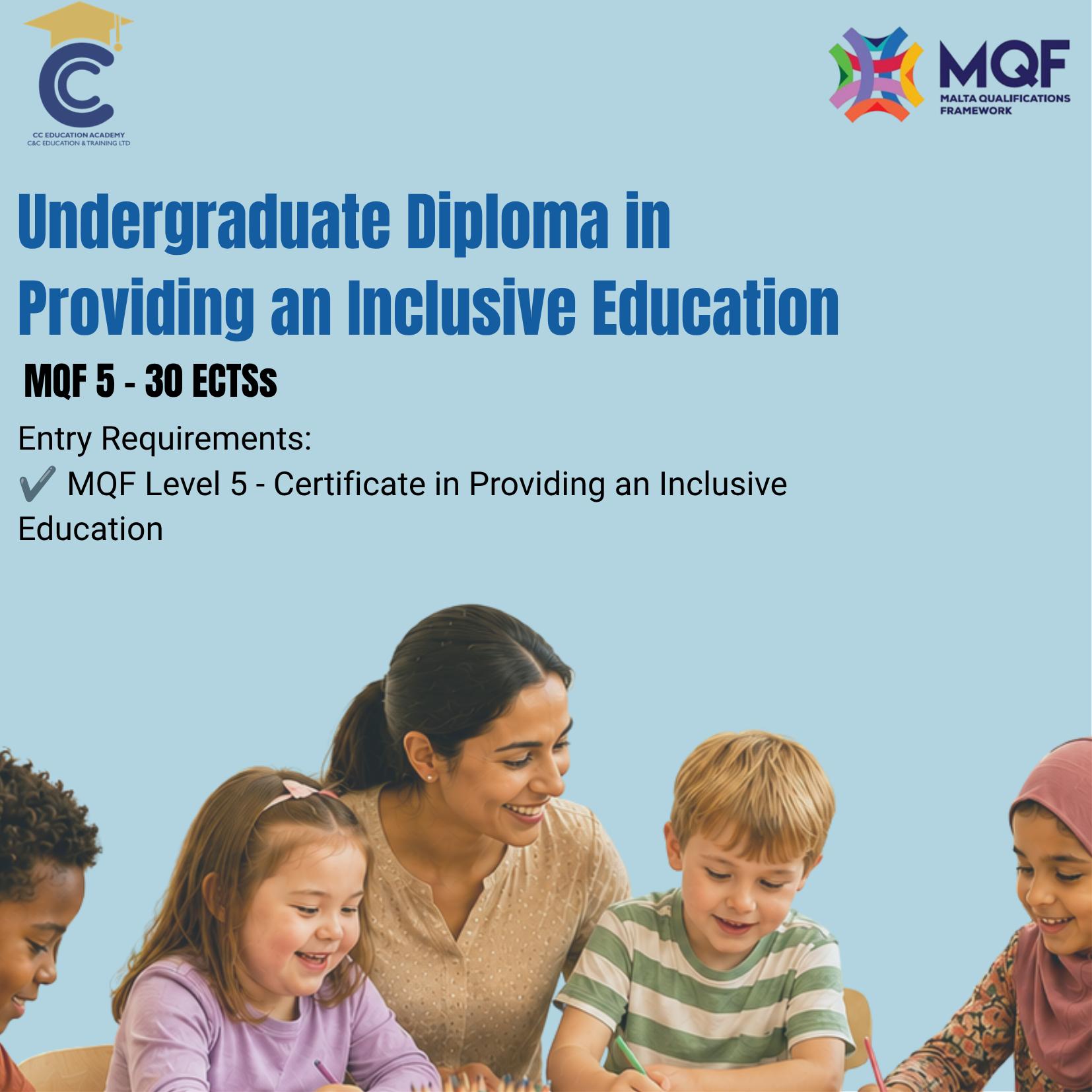
Undergraduate Diploma in Providing an Inclusive Education (aka 30 week programme)
CC Education Academy
Licensed as a Higher Education Institution by the MFHEA
Licence no. 2022-019
Course delivery: ONLINE
Language of Delivery: English/ Maltese
Placement hours: 165hrs
Total Hours (which includes self-study and assessment hours calculated according to the MFHEA guidelines) - 750hrs
Refunds
Please note that all deposits are non refundable. Please make sure you are eligible and willing to participate before applying.
The Programme
This course targets those individuals who would like to further pursue a career within the field of inclusive education and work as an Learning Support Educator (LSE). It is a follow up course and will be open to students who have already acquired the Award in Providing an Inclusive Education (MQF level 4) and the Certificate in Providing an Inclusive Education (MQF Level 5) qualifications. This course is directed at LSEs who already have a sound knowledge of inclusive education and would like to learn more. It offers specialised training in catering for specific disabilities, as well as a deeper understanding of theories. The course further delves into the life of the student as an adult and the different opportunities that will prepare them for a more independent and fulfilling adulthood.
Modules
Mode of Delivery: Online Lectures, Forum Discussion, Reading
This module gives an overview of the physical, behavioural, cognitive, and emotional-social development of adolescents. It gives special attention to issues of individuality, as well as the emotional and social changes that are associated with growth.
Assessment Methods: 20% Forum Participation and 80% Assignment
Module Learning Outcomes
At the end of the module/unit the learner will have acquired the responsibility and autonomy to:
Ensure that the students have an inclusive attitude towards each other
Carry out discussions and help their students choose the right paths for their futures based on their students’ wishes
Provide learning that is relevant to the students’ lives
Encourage independent skills
Devise methods that encourage critical thinking
Guide students to opportunities that helps them to develop their skills
List the different developmental stages
Define psychoanalytic theory; cognitive theory; learning theory; and ecological theory in terms of adolescent development
Recall the different barriers that may be encountered in society
Identify the different developmental stages that adolescents go through
Describe ways to cater for students that are struggling with societal expectations
Define ways on how to encourage critical thinking
Define 21st century skills
Define Paolo Frere’s theoretical basis on society limitations and how one can address these issues through an inclusive mentality and giving the right skills to the students
Apply their knowledge to plan a curriculum that addresses the needs of the students
Use effective techniques to identify students’ developmental needs, taking into consideration their wants and desires
Prepare an inclusive plan that caters for the individuality of the students
Apply their knowledge on diversity to encourage an inclusive attitude in schools
Practice a holistic teaching approach
Practice active listening and encourage critical thinking in schools
Devise and practice methods that will challenge their students to systematically get out of their comfort zone and acquire skills that will help them navigate the bigger world.
Mode of Delivery: Online Lectures, Forum Discussion, Reading
This module focuses on the strengths and needs of students who are on the spectrum. It delves on how to properly cater for these students, and ways on how to use their strengths to address the needs. Communication skills, social skills and typical behaviour of students with ASD are addressed in the course of this module. It further gives an explanation to the learners on how to advocate for their ASD student and how to teach the child to use their voice effectively.
Assessment Methods: 20% Forum Participation and 80% Project
Module Learning Outcomes
At the end of the module/unit the learner will have acquired the responsibility and autonomy to:
Create resources and adaptations that aim to address communication, social and behaviour skills
Ensure that the students’ needs are catered for
Carry out measures to address behavioural difficulties (such a social stories, peer preparation, buddy groups)
Create effective programs to help students with ASD to progress in their holistic development
Enable their students to use their voice in the classroom by practicing inclusive measures
Deal with situations where the students’ voice needs to be heard and advocate for such students
List and describe the common traits of ASD, according to the DSM-V
List different ways on how to cater for communication, social and behaviour needs
Recall and describe the difficulties that students with ASD may encounter in their school life and personal life
Name ways of supporting students with ASD
Recall ways of addressing behavioural difficulties and providing inclusive education in a classroom
Define the importance of good communication skills with the students
Design a plan that caters for students who are on the autism spectrum
Practice inclusive education to ensure the inclusion of all children irrespective of any limitations
Use resources to assist and help students in their educational journey
Apply acquired knowledge through this course module to cater for students in a classroom environment
Demonstrate possession of effective communication, problem-solving and critical thinking skills
Apply their knowledge on ASD to cater for students in a classroom environment
Create social stories and use video modelling to teach students with ASD specific skills and about different social situations.
Mode of Delivery: Online Lectures, Forum Discussion, Reading
This module provides knowledge on the neurodevelopmental disorders which, according to the DSM-V, can be considered as learning disabilities. ADHD, dyslexia, dyscalculia, and dysgraphia are discussed in detail in relation to learning difficulties. It aims to give knowledge on the common traits including strengths and limitations, as well as different ways on how to address the needs that are associated with SpLD.
Assessment Methods: 20% Forum Participation and 80% Assignment
Module Learning Outcomes
At the end of the module/unit the learner will have acquired the responsibility and autonomy to:
Create resources and adaptations related to difficulties that are common for students with SpLD
Be responsible to identify the learning difficulties of students
Ensure that their students’ learning journey in one subject is not stalled by limitations in other areas Practice effective planning and development of reports and referrals in a professional manner
Communicate and cooperate with other professionals to offer continuation of the learning journey at school
Compose a coherent report that aims to give holistic profile and the specific strengths and needs
Demonstrate the ability to assess situations where other services may be needed
Prepare a typed report making use of digital software
Use electronic mail effectively to communicate with others
Define UDL, differentiation and other teaching methods
Define the meaning of SpLD
Describe and list the main characteristics of dyslexia, dyscalculia, dysgraphia, and ADHD
Identify ways on how to address the needs associated with SpLD
Identify the strengths of students with SpLD, to help them address the needs
Define the Concrete-Pictorial-Abstract method (CPA)
List different ways on how to encourage literacy and facilitate learning in this subject
Describe different methods and adaptations that may help students to address writing difficulties
Identify ways on how to improve attention span
Practice different methods of instructions to help their students achieve academic goals
Design and use available adaptations and resources to address the difficulties of their students
Apply methods that help students who are experiencing difficulties sustaining attention in class
Use different teaching methods, to enhance the ability of their students’ academic ability.
Mode of Delivery: Online Lectures, Forum Discussion, Reading
The aim of this module is to provide learner with information about the social, emotional, and behavioural difficulties that are sometimes exhibited in students. It also aims to explore the manifestation of acting in behaviour as well as acting out and giving importance to both. The module further delves in the formulation of resources aimed to address unwanted behaviours and to improve the students’ emotional intelligence.
Assessment Methods: 20% Forum Participation and 80% Project
Module Learning Outcomes
At the end of the module/unit the learner will have acquired the responsibility and autonomy to:
Create a plan of action to deal with specific unwanted behaviours
Ensure use of effective and relevant resources to encourage emotional growth
Be responsible for taking action to exercise restorative justice with the students
Ensure that students’ emotional and social growth is addressed
Encourage students’ self-awareness
Define SEMH
Identify strategies that cater for different behaviours
Cite studies that are related to SEMH
List different strategies that may aid the social and emotional growth of the students
Name different ways on how to target challenging behaviours
Define theoretical findings in relation to behaviour modification
Practice good observation skills that enable them to identify different behavioural changes
Create adaptations and strategies that aid the students’ emotional growth
Prepare plans of action to address behaviours
Practice restorative justice in the classroom
Apply their knowledge of SEMH to assemble and present resources associated with behaviour modification, social development, and emotional growth
Mode of Delivery: Online Lectures, Forum Discussion, Reading
This module aims to enhance the learners’ previous knowledge on technological use and help to present different ways on how to use technology to aid in the students’ educational journey. It also targets the use of technology as a communication device with students and other professionals
Assessment Methods: 20% Forum Participation and 80% Project
Module Learning Outcomes
At the end of the module/unit the learner will have acquired the responsibility and autonomy to:
Create different resources and projects using technology
Carry out different tasks using a variety of technological devices
Be responsible for communicating with the other professionals using technology
Use assistive technology effectively
List different programs that may help with creation of resources
Identify the different ways that technology can be used in classrooms
Describe how the school tablet can be used to aid students’ learning
Name the different methods that can be used to communicate with other professionals
List the rules of etiquette that should be practiced when communicating via technological devises with other professionals
Describe different methods of presenting learning using technology
Identify the importance of assistive technology for students with disabilities
Show proficiency when using TEAMS
Operate the school tablet efficiently
Prepare resources using different applications and software
Make the best use of the interactive whiteboard software
Use technology in order to communicate with the child, the parents and create resources.
Create resources and presentations to address the students’ educational needs
Use the different technological devices available
Mode of Delivery: Online Lectures, Forum Discussion, Reading
This module aims to present more detailed knowledge on the different learning theories and their application to the classroom.
Assessment Methods: 20% Forum Participation and 80% Multiple choice test
Module Learning Outcomes
At the end of the module/unit the learner will have acquired the responsibility and autonomy to:
Create evidence-based resources and adaptations
Carry out tasks that ensure scaffolded learning, UDL and differentiation are practiced
Define the theory of constructivism in relation to social learning and scaffolded instruction
Describe how taking a humanistic approach to learning helps students perform better
Differentiate between the learner-centred approaches and teacher-centred approaches
Define DL and differentiation
Describe the importance of connectivism in relation to technology
Apply their knowledge on learning theories to use different strategies that accommodate their students’ needs and preferences
Practice UDL and differentiated instruction in the classroom
Prepare different educational plans according to their students’ needs, using a combination of the theories learnt
Differentiate learning material
Use a learner-centred approach
Mode of Delivery: Practice Placement in a school
This module allows learners to put to practice what the skills, knowledge, and competence that they have acquired at the workplace. Learners will have to meet a set of learning outcomes and demonstrate ability to work with students and carry out the tasks required from an effective and successful LSEs.
Assessment Methods: 20% Online interview, 40% Presentation of File and 40% Visits
Module Learning Outcomes
At the end of the module/unit the learner will have acquired the responsibility and autonomy to:
Collaborate with superiors and colleagues at the workplace
Carry out tasks provided by workplace successfully
Monitor behaviour of learners and tailor education experience for the requirements and needs of the learners
Attend to the needs of learners in an effective manner
Produce an effective portfolio portraying one’s work
Describe the importance of reporting and journaling throughout the practice placement
Write an effective portfolio including all required material and resources
List the strengths and requirements of the student in their care
Recall the types, causes and characteristics of various disabilities
List the requirements for high quality of inclusive education
Demonstrate ability to implement the methods and techniques learnt throughout the sessions at the workplace
Use knowledge acquired on disabilities to be cater for the needs of the student
Show knowledge on the diverse types of disabilities, and relevant strategies
Analyse their own learning and implement various strategies to accommodate and provide a tailor-made experience to learners in their care
Create resources that cater for their students’ needs
Form attachments with their students to enable a healthy learning environment
Create resources suitable for the child’s age and abilities.
Create activities that show creativity and innovation
Use the LSE toolkit created throughout the previous units
Communicate effectively with the tutors to discuss the placement
Keep track of the child’s progress according to the LO Framework
Create flashcards, power point presentations and worksheets
Design games and interactive activities that will fit in with the child and the topics learned at school
Learning Outcomes
Knowledge
• Recall the stages of development according to the theories learnt
• Define the stages of adolescent development, with special reference to the different barriers and changes, and explain how to promote and encourage individuality
• Identify the traits of ASD, ADHD, SpLD, and SEMH
• Define the different strengths and needs of students who are diagnosed with ASD, ADHD, SpLD, and SEMH
• List ways to address the difficulties of students with diverse needs
• Describe ways to help students develop their emotional intelligence to deal with social situations
• Identify the most effective ways of using IT in their work life
• List different services and opportunities available, including further education as well as job assistance
• Define the term “21st century skills”
• Define learning theories in detail and explain their application in classroom situations
• Define and list disabilities that are categorised as SpLD
• Describe the purpose of UDL (Universal Design for Learning) and differentiated instruction
Learning Outcomes
Skills
• Plan and create relevant support plans for students with diverse needs, using their strengths to address their needs
• Use knowledge to accommodate the social, emotional, and behavioural needs of students
• Use knowledge of different disabilities to anticipate limitations that may occur, keeping in mind that children are individuals and that a label does not define their abilities or limitations
• Demonstrate sound knowledge of using the PC for administrative tasks such as the provisional map and everyday tasks like sending electronic mail
• Show the ability to use the PC for creating resources and as an educational tool
• Prepare students for society by giving them social and independent skills as well as emotional support
• Practice an inclusive attitude towards students, respecting diversity and individuality
Please note that all payments are non-refundable.
+ €20 registration fee
Course information remains available. New registrations and waiting-list places are not being accepted at this time.