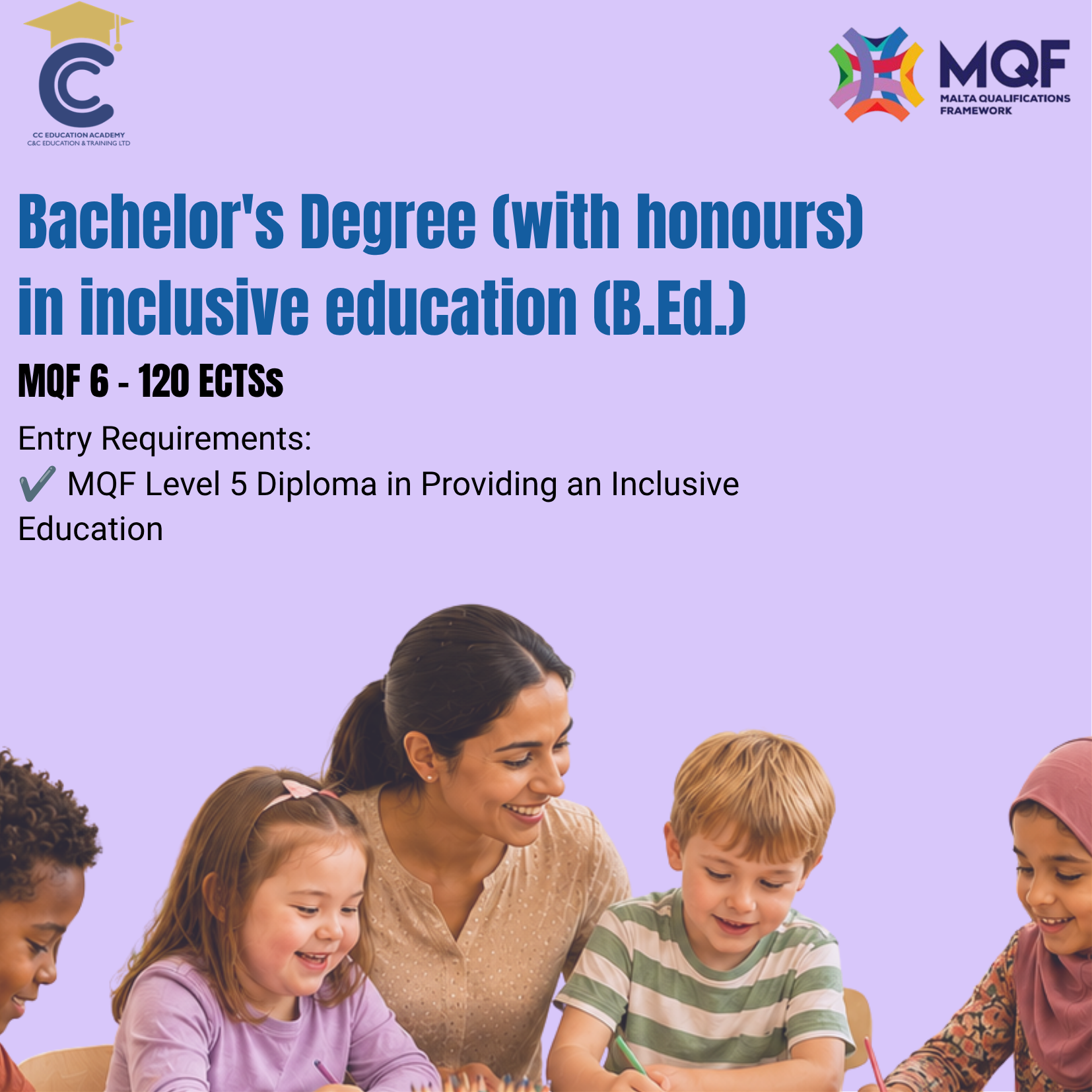
Bachelor's Degree (with honours) in inclusive education (B.Ed.)
CC Education Academy
Licensed as a Higher Education Institution by the MFHEA
Licence no. 2022-019
Course location: ONLINE
Placement hours: 165hrs
Course duration: Approximately 2 years on a part-time basis - Only for students who are already in possession of a Certificate and Diploma in Providing an Inclusive Education (Total of 60ECTSs)
Language of delivery: English/ Maltese
Total Hours (which includes self-study and assessment hours calculated according to the MFHEA guidelines) 3750hrs
Programme Structure
If students are already in possession of the Certificate in Providing an Inclusive Education (30ECTSs) and the Diploma in Providing an Inclusive Education (30ECTSs), the following structure will be followed:
In the first academic year, the students will have finished the following modules:
Academic Writing (4 ECTS)
Teaching language and literacy to students with diverse needs (4 ECTS)
Teaching Mathematics to students with diverse needs (4 ECTS)
The emergent curriculum: Early years education (4 ECTS)
Social Justice in the classroom (4 ECTS)
Children’s Rights (4 ECTS)
Behaviour management and Restorative justice (4 ECTS)
Diverse needs (20 ECTS)
Learning through play (4 ECTS)
Technology in the classroom (4ECTS)
The Multicultural Classroom (4 ECTS)
Research Methods (4 ECTS)
Practice Placement (20 ECTS)
(84 ECTS)
In the following semester, the learners will cover the following remaining modules:
Disability rights (4 ECTS)
Sexuality and gender (4ECTS)
Mental Health (4 ECTS)
Long essay (20 ECTS)
(32 ECTS)
During the course, the learners will also be given the opportunity to choose from the following three elective modules:
Sign language (4ECTS)
Parental advocacy (4 ECTS)
Mindfulness (4 ECTS)
Target Audience
The programme is for students who are already in Possession of the Certificate and Diploma in Providing an Inclusive Education (MQF5) and would like to further their knowledge in the field.
Entry Requirements
In possession of the Certificate and Diploma in Providing an Inclusive Education (MQF 5)
Grading
Learners must achieve a minimum score of 50% in each module to qualify for certification.
Student Success Rate
The first programme started end of 2023 and as yet, the first cohort has not finished. Therefore, no accurate percentage can be given.
Refunds
Please note that all deposits are non refundable. Please make sure you are eligible and willing to participate before applying.
The Programme
This programme will focus on different aspects of inclusive education. The academic aspect of teaching will be tackled, including numeracy and literacy, early years education as well as the different research available regarding inclusive techniques. It will also focus on specific diverse needs and behavioural management. Also, the programme will deal with the holistic education of the students, including mental health, for the students to be active and informed citizens as well as discipline, in all its aspects. In addition, parental involvement and children’s rights will also be examined, as well as different issues including sexuality and gender, and the educational journey of students from all cultures.
Modules
Mode of Delivery: Online Lectures, Forum and Reading material
The module focuses on the expectations from a learner at degree level throughout this course. Different aspects of academic writing are discussed, including, but not limited to proper writing, formal vocabulary, presentation, the importance of crediting authors, referencing tools, how to read and conduct basic research from peer reviewed material.
Assessment Method: Multiple choice test (60%) and Literacy study (40%)
Module Learning Outcomes
At the end of the module/unit the learner will have acquired the responsibility and autonomy to:
Be able to read peer-reviewed journal articles and books that are with a critical mindset
Research topics using accredited sources
Write academic essays that use critical thinking, raise pertinent questions and have arguments that flow rationally
describe the procedure that one should follow to conduct an academic task
list the different components found in academic writing
write an assignment that’s of an adequate level, using correct usage
identify the importance of research prior an academic task
identify readings that are relevant to different topics
list the preparations needed prior working on academic writing
Demonstrate knowledge on how to find and discern between sources of information
Compose academic writing of an appropriate level
Apply their knowledge on academic writing to identify common mistakes
Search for research papers, gather information, critically analyse and compose writing that’s of an academic level.
Make use of technology as a research tool
Mode of Delivery: Online Lectures, Forum and Reading material
The module aims to introduce language teaching. The different language theories are discussed, as well as the various aspects of Malta’s national languages – Maltese and English. It will also delve into the linguistic aspects of both languages; phonology, morphology, syntax, semantics, and pragmatics. The module further elaborates on how to teach students with diverse needs, with reference to SpLD and other disabilities. Practical explanation on the use of the Learning Outcome Framework and its assessment methods are given during this module.
Assessment Method: Preparation of resources and assignment (50%), Test (40%) and Forum input (10%)
Module Learning Outcomes
At the end of the module/unit the learner will have acquired the responsibility and autonomy to:
Identify the current level of their students according to the LOs
Ensure that they choose the appropriate language goal for their students
Create resources and adaptations for their students to reach the language goal
Ensure that the students’ needs are met
Describe the different language theories and know how these theories are applied in classroom practice
Label the different language components in Maltese
Label the different language components in English
Write using proper grammar and syntax when writing in both languages
Recall the various principles whereby the LOs are based on
Define the difficulties that students might encounter when dealing with students with diverse needs and cater to these needs
List the assessment methods that should be used according to the Los, and be aware of what assessment methods are suitable for children with learning disabilities
Match the teacher’s LOs with a similar LO in a lower/higher level, depending on the students’ needs
Identify different ways on how to help their students achieve their language goals, using scaffolding, shaping, differentiation and multisensory teaching.
List the current language level of their students
Identify the difficulties that students with SpLD might encounter when learning a language
Know how to use technology to further help children with learning disabilities and other children who might struggle in the classroom
Apply their knowledge of the LOs to devise goals that are relevant to their students
Practice different assessment methods when working with their students
Design different resources to meet the needs of their students
Create different resources that meet the needs of their students
Show understanding of what strategies will work with their students
Proficiently use the LOs to devise a plan on how to help the students in language learning
Prepare resources to address the needs of the students in the language
Design different adaptations that are relevant to a teacher’s lesson to meet the specific needs of a student
Mode of Delivery: Online Lectures, Forum and Reading material
This module focuses on giving the learners information on how to go about teaching mathematical concepts. The CPA approach is explained in detail and put to practice, for learners to devise different learning strategies and adaptations. The module also references dyscalculia, which is a disability that directly impacts the students’ ability to learn mathematical concepts using traditional methods.
Assessment Method: Case study (40%) and Project (60%)
Module Learning Outcomes
At the end of the module/unit the learner will have acquired the responsibility and autonomy to:
be responsible for teaching mathematics to students with different abilities
create various resources that will aid the students’ learning journey in the mathematical subject
carry out lessons that make learning meaningful to their students
monitor the students’ progress in Mathematics using the LOs
ensure that the goals set for the students are scaffolded according to the ZPD
Define the main mathematical concepts
Identify the needs of the students when approaching mathematical learning
List different ways on how mathematical concepts can be taught
Identify the various needs of students with IEN, in relation to mathematical learning
Define the different needs and strategies that can be used with students who have dyscalculia
Find ways on how the CPA approach can be used in the classroom
Identify different assessment methods that can be used when reporting a student’s progress
Apply their knowledge of the CPA approach to prepare resources related to teaching mathematics
Plan math lessons according to the teacher’s lessons, making sure the LOs chosen are relevant to their student’s current level
Create resources that will aid the students to learn mathematical concepts
Practice meaningful mathematical teaching
Practice differentiated teaching so that content, process, and product are all relevant to the student’s needs
Practice the CPA approach
Apply their knowledge of dyscalculia and other IEN to address the needs of the students in the learning of mathematics
Create resources and adaptations to aid the process of learning new mathematical concepts
Use technology as a resource to teach new mathematical concepts
Mode of Delivery: Online Lectures, Forum and Reading material
This module focuses on the early years, where the Emergent curriculum is discussed. A practical aspect is taken, to prepare the learners on how to use the document in their teaching. The Early Years LOs will also be discussed, and the different levels and subject areas will be explained in detail.
Assessment Method: Short Assignment (40%), Test (40%) and Forum participation (20%)
Module Learning Outcomes
At the end of the module/unit the learner will have acquired the responsibility and autonomy to:
Be responsible for teaching students in the early years
Ensure that all aspects of the LOs and the Emergent curriculum are being practiced
Create resources to facilitate the goals of the LOs
Be responsible for the holistic education of students in the early years
Be responsible in adopting the Reggio Emilia approach in their teaching
Define the principles of the Emergent Curriculum and the LOs
Identify the relationship between child development and the Emergent Curriculum
List the different observation/assessment methods that can be used to test understanding and progress of their students
Describe the process by which the Emergent curriculum can be put in practice
Recall the importance of the Emergent Curriculum in relation to children’s rights
Practice correct pedagogy with students in early years, in par with their stages of development
Show ability to use LOs
Construct different resources that facilitate their students’ learning according to the children’s interests
Apply their knowledge of the LOs, the children’s interests, and the emergent curriculum to devise a plan for their students
Plan how to address different goals in an activity, using a constructivist approach
Apply their knowledge of the LOs to find goals for their students
Devise and construct different resources
Plan an activity that covers different subject areas
Put into practice the constructivist approach
Use technological resources to reach different goals in the early years
Mode of Delivery: Online Lectures, Forum and Reading material
This topic delves further into the nature of creating an inclusive environment, with special focus on social justice and how to better address the barriers that students might encounter. The module aims to make the learners aware of their role as a LSE in the process of creating a just society. Different advocates of social justice and inclusion are introduced, and their perspectives discussed.
Assessment Method: Essay (50%), Multiple Choice Test (30%) and Forum Input (20%)
Module Learning Outcomes
At the end of the module/unit the learner will have acquired the responsibility and autonomy to:
Deal with different situations that require advocacy
Collaborate with class teacher to create a more inclusive environment
Be responsible for identifying barriers around us that may hinder the progress of different social groups
Create a more inclusive environment in schools
Deal with different situations that they might encounter, where social injustice is present
How to recognise their own beliefs and self-reflect on their own thoughts as regards to social justice
Identification of the different social groups that may be suffering from injustice
The different efforts around the world that have tried to address inequalities
The outlook and theories presented by different advocates for social justice
The relevance of social justice when applied to creating an inclusive environment
How to gather information about different social groups and their efforts
Awareness about efforts and changes made by the local educational institutions to create a more inclusive environment
The ability to demonstrate a sound knowledge of what social justice entails
How to apply their knowledge on social justice in the classroom
How to plan different strategies to address social injustice and lack of inclusion in a classroom environment
The practice of inclusive approaches to be part of the inclusive process
Demonstrate sound knowledge of the different barriers found in schools
Practice inclusive pedagogy
Apply their knowledge on social justice to address the barriers
Mode of Delivery: Online Lectures, Forum and Reading material
This module builds on the learner’s knowledge on children’s rights and introduce different ways on how to protect them. It gives information on how to handle different situations where the students’ rights might be overlooked. The module identifies the different aspects of inclusion and why it is related to the children’s rights. It also focuses on appropriate observational techniques that a LSE, in his/her role as an educator, must practice. An overview of different local institutions that provide assistance is also be given.
Assessment Method: Test – Long answers (30%), Assignment (50%) and Forum Input (20%)
Module Learning Outcomes
At the end of the module/unit the learner will have acquired the responsibility and autonomy to:
Ensure that children’s rights are protected for the students in their care
Supervise the students’ well being
Monitor the different aspects of the students in their care to make sure that their right to holistic education is upheld
Represent the needs of their students when participating in meetings
Be responsible for teaching their students about their rights
Guide their students towards knowing what their rights are and how to be advocates for themselves, while being aware that there is help
Identify the meaning of the children’s rights
Recall the name of different local NGOs that might help if faced with a breach of children’s rights
Identify the process by which action should be taken if a student at school shows signs of distress due to abuse
How to formulate a report when faced with a situation where an incident has to be referred due to suspicion on breach of children’s rights
Apply their knowledge on advocacy and children’s rights in the classroom
Practice inclusive pedagogy
Demonstrate a sound knowledge on the children’s rights, as well as the process of referring a breach of such rights
Mode of Delivery: Online Lectures, Forum and Reading material
This module identifies the different behaviour difficulties found in schools and aim to explain the effectiveness of restorative justice in addressing these behaviours. Restorative justice is the basis of the Behaviour policy upheld by the local educational institutions, and therefore it is important that all educators have a sound knowledge on how to practice it in schools.
Assessment Method: Groupwork task (40%), Assignment (40%) and Forum participation (20%)
Module Learning Outcomes
At the end of the module/unit the learner will have acquired the responsibility and autonomy to:
deal with behavioural difficulties they might encounter in schools
ensure that they are doing their part in creating a safe and loving environment for all student
collaborate with the school team to take part in implementing restorative justice in schools
create a community within the students whereby restorative justice is accepted and practiced
define restorative justice
identify different behaviour difficulties in schools
identify ways on how to implement restorative justice
describe the different ways one can practice restorative justice in schools
identify ways how restorative justice can help the perpetrator as well as the victim
practice restorative justice in the classroom
design different strategies that aid students to understand restorative justice
create a plan on how to address common behaviour issues
practice restorative justice to address behaviour difficulties
use different techniques to make sure students are emotionally aware, and to help them understand the principles of restorative justice
Mode of Delivery: Online Lectures, Forum and Reading material
This module discusses various disabilities, including, but not limited to:
Communication and language disorders
Rare conditions
Profound Multiple disabilities
Gifted education
Assessment Method: Forum participation (20%), Case studies (40%) and Community work (40%)
Module Learning Outcomes
At the end of the module/unit the learner will have acquired the responsibility and autonomy to:
cater for students with diverse disabilities
create programs that address difficulties in the four developmental areas
create resources and adaptations to cater for students with diverse needs
collaborate with different professionals that may help students in different developmental areas
monitor the progress of the students, to ensure that they are given a holistic education
describe the nature of different disabilities
identify the areas that may need to be addressed, according to the disability
find information on different strategies that are commonly used
identify the different areas that various professionals are responsible for
name the different strengths and needs that are usually present in students with the disabilities
prepare different resources to cater for all developmental areas
design programs that cater for the students’ needs, by using the strengths
construct resources for students with diverse needs
prepare an IEP for the diverse needs of students using SMART goals, using case studies of students with different disabilities
show initiative and teamwork when working with others
apply their knowledge in practice during the practical side of this module
show a positive attitude towards students with diverse needs
Mode of Delivery: Online Lectures, Forum and Reading material
This module focuses on the importance of kinaesthetic learning and how educators can incorporate different subject areas through play. The module also focuses on the importance of discovery learning.
Assessment Method: Forum Participation (20%), Presentation (30%) and Assignment (50%)
Module Learning Outcomes
At the end of the module/unit the learner will have acquired the responsibility and autonomy to:
carry out different lessons that involve kinaesthetic learning
create various activities that include discovery learning
be responsible for the holistic education of the students
ensure that they are giving the students a meaningful education
cater for students with different learning styles
identify play activities that match the child’s interest and their developmental stage
define meaningful learning
describe the importance of learning through play
list the different benefits of discovery learning
list different ways how kinaesthetic learning can be incorporated with lessons
define what is meant by holistic learning
define the VARK method, and how play is a meaningful part of the educational journey
practice meaningful teaching through play
show the ability to incorporate learning through discovery
create different lesson plans that incorporate kinaesthetic learning
design meaningful lessons for students who have different learning styles
create different lesson plans and adaptations based on the learning style of their students
Mode of Delivery: Online Lectures, Forum and Reading material
This module discusses the importance of technology in the students’ learning journey. Practical work and methods are discussed and taught throughout the sessions. Furthermore, the lessons also focus on the availability of different assistive technology that is available, and how it can facilitate the students’ lives
Assessment Method: Forum participation (20%) and Project (80%)
Module Learning Outcomes
At the end of the module/unit the learner will have acquired the responsibility and autonomy to:
create interesting lessons using technology
produce resources that can reach the learning outcomes using technology
describe the aim of different devices that may help students
name different types of assisted technology
identify the benefits of technology in the learning process of the students
identify the different ways where technology can embellish lessons in relation to the VARK method
apply their knowledge of different PC programs that might help the students learn
create different resources for the students using technology
use technology as a tool when preparing lessons
prepare PPTs, games and IWB lessons for their students
prepare different lessons using technology
Mode of Delivery: Online Lectures, Forum and Reading material
The module focuses on the inclusive measures that should be taken in relation to students coming from different communities. Classrooms in Malta are diversified, with students coming from different areas of the world, and we need to cater for their needs as much as we possibly can. This module helps the learners understand the importance of knowledge, empathy and a diversified curriculum, so that an inclusive environment and quality education is available for all students, regardless of their background, cultural differences, language barriers and other differences.
Assessment Method: Forum participation (20%) and Project (80%)
Module Learning Outcomes
At the end of the module/unit the learner will have acquired the responsibility and autonomy to:
ensure that an inclusive classroom is available to everyone
carry out inclusive measures that address different barriers
create different adaptations that cater for students with different barriers
deal with situations where lack of acceptance is causing distress and difficulties in the classroom
collaborate with the teacher to provide a holistic education for all students, regardless of all the differences
describe the various cultural differences
identify the main beliefs and traditions that students from different countries might have
find ways how to address the barriers that students from other parts of the world might encounter when learning in a Maltese environment
define the benefits of a multicultural classroom
apply their knowledge of the barriers to address the difficulties that students from different countries might encounter
create programs and activities that help create an inclusive classroom
practice an inclusive methodology that uses students’ strengths and celebrates the differences
use different ways of teaching to address the needs of students who come from different countries
practice inclusive measures to provide a quality education that celebrates differences
apply their knowledge on the difficulties that multicultural students might encounter, to provide a safe and inclusive environment and address their social and emotional needs
Mode of Delivery: Online Lectures, Forum and Reading material
The module provides guidelines on how to create a research paper that is effective, with proper research and presenting an effective and relevant literature review, following the ethical principles and proper research methods. The module aims to prepare the learners for the long essay, so that the learners can start working on creating a good research question, choose a proper method for research and collect relevant readings and papers.
Assessment Method: Presentation of research title and research plan (100%)
Module Learning Outcomes
At the end of the module/unit the learner will have acquired the responsibility and autonomy to:
produce an effective research question that addresses a gap in educational research
be responsible for choosing good research material that they will further use in their long essay
identify different research methods: qualitative, quantitative, and mixed method approaches
describe different ways to gather data
define the importance of the different components in a research paper
critically analyse a research paper to find the information needed
write an effective literature review that is relevant to the research
name the different components found in the research papers
define the importance of ethical considerations when doing research
prepare an effective research question
apply their knowledge of the different methods of research to choose an appropriate method and data collection tool, relevant to their chosen research question
use their knowledge on the ethical aspect of research to make sure appropriate care is taken during their long essay
assemble the necessary readings needed for their long essay to create an effective literature review
create a relevant research question that addresses a gap in research
create an effective long essay that includes the necessary components
Mode of Delivery: Online Lectures, and Placement in a school
This module allows learners to put to practice what the skills, knowledge, and competence that they have acquired, at the workplace. Learners will have to meet a set of learning outcomes and demonstrate ability to work with students and carry out the tasks required from an effective and successful LSEs.
Assessment Method: 20% Online interview, 40% Portfolio and 40% Visits
Module Learning Outcomes
At the end of the module/unit the learner will have acquired the responsibility and autonomy to:
Collaborate with superiors and colleagues at the workplace
Carry out tasks provided by workplace successfully
Monitor behaviour of learners and tailor education experience for the requirements and needs of the learners
Attend to the needs of learners in an effective manner
Produce an effective portfolio portraying one’s work
Describe the importance of reporting and journaling throughout the practice placement
Write an effective portfolio including all required material and resources
List the strengths and requirements of the student in their care
Recall the types, causes and characteristics of various disabilities
List the requirements for high quality of inclusive education
Demonstrate ability to implement the methods and techniques learnt throughout the sessions at the workplace
Use knowledge acquired on disabilities to be cater for the needs of the student
Show knowledge on the diverse types of disabilities, and relevant strategies
Analyse their own learning and implement various strategies to accommodate and provide a tailor-made experience to learners in their care
Create resources that cater for their students’ needs
Form attachments with their students to enable a healthy learning environment
Create resources suitable for the child’s age and abilities.
Create activities that show creativity and innovation
Use the LSE toolkit created throughout the previous units
Communicate effectively with the tutors to discuss the placement
Keep track of the child’s progress according to the LO Framework
Create flashcards, power point presentations and worksheets
Design games and interactive activities that will fit in with the child and the topics learned at school
Mode of Delivery: Online Lectures, Forum and Reading material
This module focuses on the rights for people with disability, not only in the school environment but also in the community. As educators, the aim is to prepare the students for society. We must arm the students with knowledge and understanding on what their rights are, and how they can become participants in their lives. We must also create an accepting and fair society. When the learners are knowledgeable on the rights, they can teach them to the students, and make sure that an inclusive society is in place for everyone.
Assessment Method: Forum participation (20%), Multiple choice questions (40%) and Group work (40%)
Module Learning Outcomes
At the end of the module/unit the learner will have acquired the responsibility and autonomy to:
ensure that their students’ rights are protected within the school
be responsible for giving their students a sense of agency, where they will be able to protect their own rights, or those of others
carry out activities that prepare their students for the future
create a sense of community within their classroom
deal with barriers that might be encountered when disability rights are not protected
be responsible for protecting their students’ rights, acting as their advocates if they need a voice
define the importance of disability rights
describe the different aspects of the policies that are upheld within the education division
identify different ways on how their students can be helped to find their voice within a society
define the different barriers that may be encountered when disability rights are not respected
name situations whereby disability rights are not respected
identify the role of the parents when advocating for the students’ rights
list different Maltese associations that are working towards a more inclusive society
prepare their students for society, by giving them a sense of control in their own lives
plan on how to develop a sense of fairness and justice in all students
demonstrate knowledge and understanding on disability rights, as well as on associations that are working towards a more inclusive society
using technology to contact advocacy groups that can give advice regarding disability rights
Mode of Delivery: Online Lectures, Forum and Reading material
This module focuses on creating a clear understanding on sexuality and gender. A clear explanation on the different aspects of the topic is offered, aiming to eliminate misconceptions and negative views on societal groups, that may stem from lack of knowledge. The objective is to create a welcoming society from the learners themselves, which in turn will be reflected and passed on to their students.
Assessment Method: Forum participation (20%), Multiple choice test (30%) and Assignment (50%)
Module Learning Outcomes
At the end of the module/unit the learner will have acquired the responsibility and autonomy to:
deal with situations whereby some societal groups may be suffering from injustice
ensure that schools are safe and welcoming to all students
identify the difference between sexuality and gender
list the difficulties that some students may encounter, in regard to being accepted as part of society
identify representational barriers that might be hindering the inclusive process of students who may be seen as different
describe how hard topics can be addressed in an age-appropriate manner
practice inclusive ideology in their class
create an accepting environment for students going through bullying and/or personal battles
make sure everyone feels safe and accepted during their educational journey
Mode of Delivery: Online Lectures, Forum and Reading material
The module focuses on the importance of mental health. It delves into diagnosable mental disorders, as well as the importance to look out for signs of deterioration of mental health in students. The module also aims to de-stigmatise mental health and create awareness of its importance.
Assessment Method: Forum participation (20%), Multiple choice questions (40%) and Group work (40%)
Module Learning Outcomes
At the end of the module/unit the learner will have acquired the responsibility and autonomy to:
monitor and look out for signs of mental health struggles in their students
create a safe space for their students to share their feelings
deal with situations where reporting and referral to professionals is needed
collaborate with teacher to create a happy and safe environment in the classroom
create programs that ensure self-awareness and emotional literacy for their students
describe what is meant by mental health, and how it can be impacted from outside as well as inside stimuli
define different mental disorders
find ways on how to prevent mental health deterioration
identify the importance of self-awareness and emotional literacy
define the importance of building a good relationship with their students
identify the relationship between behaviour and mental health
demonstrate a good understanding of mental health
create programs that target self-awareness and emotional literacy for their students
prepare goals for emotional literacy
practice appropriate techniques to ensure mental health in classrooms
create self-awareness and emotional awareness within their students
Mode of Delivery: Individual assistance by tutor re. Independent research, reading and maintaining a reading log.
This long essay takes form of a thesis, where the learners are asked to do a research study within their school placement. Guidance is offered throughout individually, and a tutor is assigned to every learner to offer guidance throughout.
Assessment Method: Long essay (100%)
Module Learning Outcomes
At the end of the module/unit the learner will have acquired the responsibility and autonomy to:
create a short research project that concerns educational topics
ask for appropriate permissions to do the research
be responsible for doing the research, with guidance
describe the main components of a research project
identify the importance of ethical considerations
write a research project including Abstract, Introduction, Literature Review, Methods, Results, Discussion, and Conclusion
Derive appropriate conclusions as a result of their research
identify appropriate research methods in line with their question
define the importance of research in education
write a relevant literature review in line with their research question
compose an ethically sound research project
design the research tools and use the tools effectively
prepare a research project that is effective and in line with the research question
arrange the data collected to derive good data
discuss the results backed by peer reviewed documentation and the data collected
create a sound research project
Mode of Delivery: Online Lectures, Forum and Reading material
This module familiarises the learners with Maltese Sign Language. The lectures are given in sign language by a lecturer approved by the Deaf Association of Malta.
Assessment Method: Forum participation (20%) and Video (80%)
Module 18: Sign Language and Deaf Students - ELECTIVE
Module Learning Outcomes
At the end of the module/unit the learner will have acquired the responsibility and autonomy to:
Have basic communication in Maltese Sign Language
Translate a simple story in Maltese Sign Language
Maltese Sign Language
What aids are available for the deaf and their use
Causes of deafness and care of deaf students
Appropriate language and advocacy
Everyday inclusion of deaf students in the classroom
Recite the Maltese alphabet using sign language
Show basic phrases in Maltese sign language
Prepare a storytelling session using sign language
Have basic communication in sign language
Usage of the online dictionary for the deaf
Mode of Delivery: Online Lectures, Forum and Reading material
This module gives the student LSEs the other side of the coin, why parental agency is essential for their practice. It also give the learners tools to ensure that the parents’ voice to be heard and helps learners identify how to best work together with the parents for the child’s benefit.
Assessment method: Forum participation (20%) and Assignment (80%)
Module 19: Parental Advocacy - ELECTIVE
Module Learning Outcomes
At the end of the module/unit the learner will have acquired the responsibility and autonomy to:
Recognise ways of healthy communication with the parents or caregivers.
Know how to guide parents towards advocating for the child in a healthy way.
Adapt their practice so that the child’s family also benefits from inclusive practice
The different parental support agencies available in Malta
Identify ways of parental involvement improves their practice at school
Define ways on how they can be a liaison agent between home and school.
How to apply their knowledge to enhance the advocacy of the parents at school
Show ways of how both school and home can work together for the child’s benefit.
Effectively communicate with the parents not only on the curriculum content but also on the child’s physical health and mental wellbeing.
Empower the parents to better use their voice
Mode of Delivery: Online Lectures, Forum and Reading material
Recent research indicates that Mindfulness, both as a meditative activity as well as a way of life, reduces stress, helps focus and fosters empathy in both adults and children. This module explains to the learners how the principles and practice of mindfulness can help them and the children in their care. The module explores the origins and historical path of the practice, the scientific research and evidence-based practices behind mindfulness. It also encourages students to apply the tenets of mindfulness as well as engage in the practices of meditation in their daily life, before imparting the practice to the students in their care.
Assessment Method: Forum participation (20%) and Script writing (80%)
Module 20: Mindfulness - ELECTIVE
Module Learning Outcomes
At the end of the module/unit the learner will have acquired the responsibility and autonomy to:
Know where the origins of mindfulness started and how the practice was adopted in the western world
Be aware of how mindfulness is used in education around the world
Know the benefits of its use, based on research and evidence
Know what type of practice matches the type of situation
Adopt the nine tenets of mindfulness as taught by Jon Kabat-Zinn and Thich Nhat Hanh – being nonjudging, fostering gratitude, patience, a beginner's mind, trust, non-striving, acceptance, letting go, gratitude and generosity – into daily life
Be able to integrate mindfulness in their classroom practice
The origins of mindfulness
The current research
The practice of mindfulness
How mindfulness can be use in inclusive practice
Practice of living mindfully
Adapting mindfulness skills in daily classroom life
Use mindfulness as practice but also in specific situations
Sift through the resources available online and discern between what is beneficial and less beneficial.
Learning Outcomes
Knowledge
• Write academic essays appropriately, ensuring all components are present
• Describe different ways to teach language
• Be knowledgeable of teaching methods that are appropriate for language learning
• Describe the importance of UDL (Universal Design for Learning) and differentiated teaching
• Describe different ways to teach mathematics, including but not limited to the CPA (Concrete–Pictorial–Abstract) approach
• Define the importance of learning through play
• Identify the importance of the Emergent Curriculum and the Learning Outcome Framework
• Identify the importance of practicing social justice and find ways to enable a safe and welcoming environment for all
• Know what children’s rights and disability rights are, and be able to use this knowledge for discussion and advocacy
• Identify the barriers that may be present for different social groups
• Define different disabilities and know what each child needs to be included in the school community
• Find ways to use technology in the classroom as a learning tool
• Identify the struggles of students from different cultural backgrounds
• Describe the process of restorative justice and its effectiveness in behaviour management
• List different mental disorders and identify their signs and symptoms
• Identify ways to cater for gifted students
• Identify the importance of mental health
• Carry out an effective research project
Learning Outcomes
Skills
• Practice inclusive education during duties as an LSE (Learning Support Educator)
• Practice different teaching methods to teach academic subjects
• Design programmes and lessons that enable students to learn through play
• Provide a holistic education to students
• Apply knowledge of human rights to create an inclusive society within the workplace
• Prepare lessons and activities that support students’ mental health
• Contribute to a school community that supports social justice and fairness
• Design plans for students with diverse needs
• Apply knowledge of multicultural education to cater for students from diverse cultural backgrounds
• Practice restorative justice with students
• Prepare effective programmes for students
• Prepare different resources and adaptations that cater for different needs
• Design programmes that are effective and goal-oriented for students
• Carry out a research project of a standard that is acceptable at this academic level
Please note that all payments are non-refundable.
+ €20 registration fee
Course information remains available. New registrations and waiting-list places are not being accepted at this time.