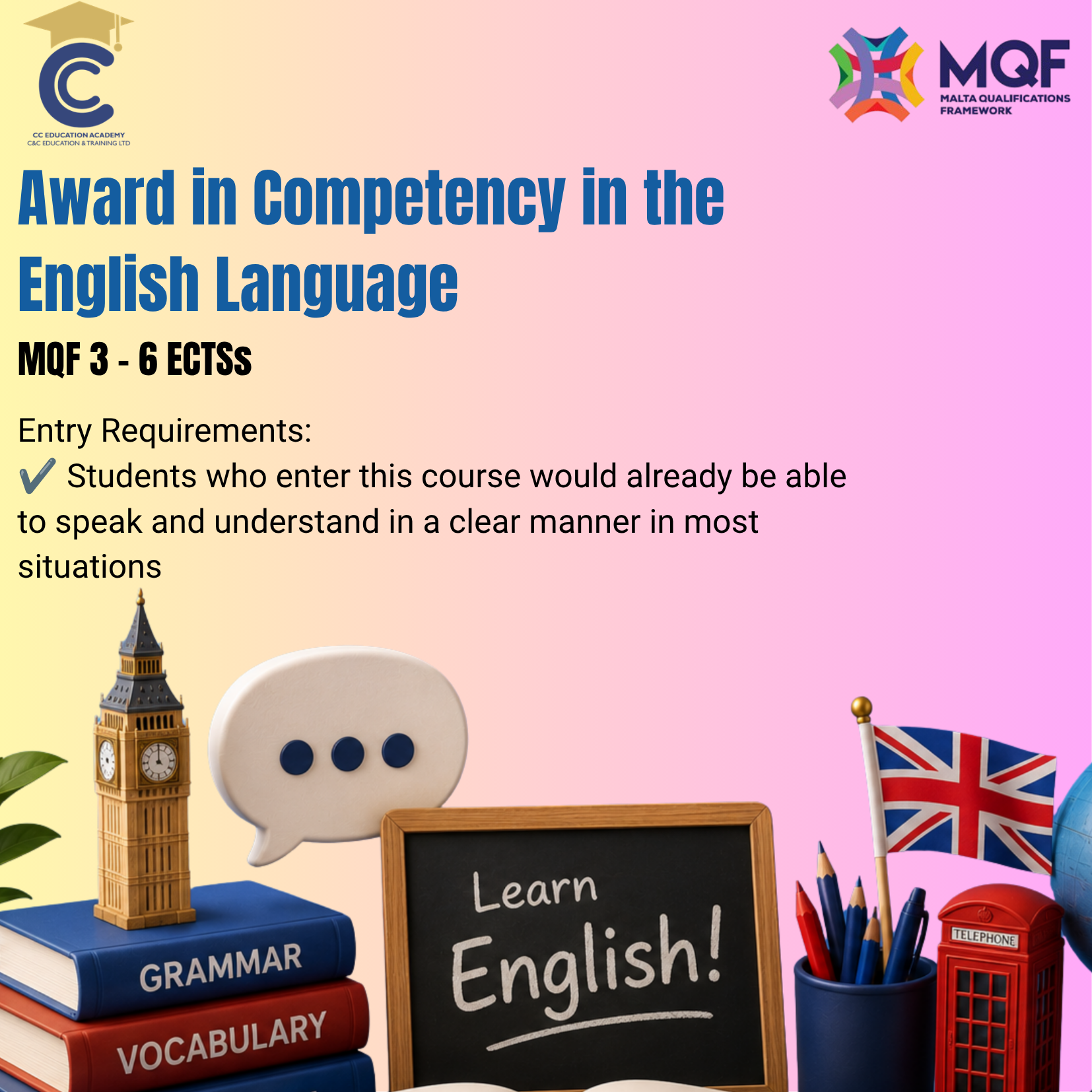
Award in the Competency of the English Language - January Intake
CC Education Academy
Licensed as a Higher Education Institution by the MFHEA
Licence no. 2022-019
Course delivery: ONLINE
Course duration: 12 weeks on a part time basis
Language of Delivery: English
Total Hours (which includes self-study and assessment hours calculated according to the MFHEA guidelines) – 150 hrs
Entry requirements
Students who enter this course would already be able to speak and understand in a clear manner in most situations.
Target Audience
This programme will equip students with the necessary qualifications to apply for an Early Years course and other programmes which ask for MQF3 Proficiency in English.
If the applicant wishes to apply for the LSE course, please note that the qualification per se does not fulfil the requirements of an O’Level, however the programme covers different areas in the syllabus of the myexams.gov.mt exams. Therefore, if the student follows the course he/she will have enough knowledge to acquire a pass in these exams.(/i)
Grading
The Grading will be assessed with a PASS/ FAIL criterion, where if the students gets a pass in every module, he she will be able to acquire the certification.
Student Success Rate
Programme success rate is 100% if excluding an average of 5% dropouts.
Refunds
Please note that all deposits are non refundable. Please make sure you are eligible and willing to participate before applying.
The Programme
This course is intended for adults who need an intermediate-level course in the English language. CC Education Academy will be providing Inclusive Education courses to prospective Learning Support Assistants, and this course will be recommended to those students who need more practice in the English language. This course will give them a twice-weekly practice session, in listening, speaking, and writing.
Modules
Each week students are given a different reading task. The task will not only involve reading and understanding but also looking out for things in the text such as attitude and inferences.
Assessment Methods: Live reading, online exercises
Grammar points will be elicited from the texts. These will be practised orally and in online exercises. Emphasis will be made on the functional aspect of the parts of speech taught, their application in writing and in spoken language.
Assessment methods: Grammar Oral exercises and online exercises
Each week will carry and different theme. Vocabulary and language connected with that theme are tackled and used in writing exercises, oral exercises, and conversation. Students will be encouraged to look up new vocabulary and use idiomatic written and spoken English.
Assessment Methods: Online and oral exercises
Students will listen to different clips each week. The purpose of listening exercises is to get students to be mindful of tone, identify contradictions, sift information to extract what is relevant, listen for attitude and opinion. These exercises will help students understand audio clips better and will also help them improve their spoken English.
Assessment Methods: Oral exercises, online games, online exercises
Speaking will take place throughout both lessons, but will given special attention in the second lesson, where 45 minutes are set aside for speaking. There will be a theme every week, and students will be prompted to use the vocabulary and language learnt during the first lesson.
Assessment Methods: Guided discussions and online interactive exercises
The writing section will consolidate all that is learnt throughout the previous sections. There will be two forms of writing, a thought-piece that is written as a reflection of the reading undertaken in independent study. This will be written in the forum section of the LMS. The second piece will be a different task each week, which will centre around the theme of the week. Students will brainstorm with the teacher; the teacher will help the students outline their plan. Students will be expected to write the task after the lesson.
Assessment Methods: Weekly tasks and Journalling
Learning Outcomes: Knowledge
By the end of this programme, the learners will be able to:
• Understand different types of text.
• Identify phrasal verbs and idioms and understand their importance in written and spoken language.
• Describe tone and attitude in a piece of writing.
• Describe the different states of verbs and their usage.
• Recall the use of modals, relative clauses, and articles.
• Understand conditionals.
• Understand word collocations.
• Recognise adjectives, adverbs, nouns, verbs, and the word patterns connecting these parts of speech.
• Recognise synonyms and words similar in meaning.
• Recall vocabulary connected with each topic.
Learning Outcomes: Skills
By the end of this programme, the learners will be able to:
• Skim, scan, and read for gist.
• Paraphrase texts.
• Draw inferences and conclusions from texts and audio clips.
• Use modals in conversation and writing.
• Apply question tags in conversation.
• Use passive and active voice appropriately.
• Practice writing emails.
• Choose style according to type of writing.
• Express opinions, give reasons, and make suggestions in written and spoken language.
• Write instructions, descriptions, and narratives.
• Discern between relevant and irrelevant information in text or audio clips.
Please note that all payments are non-refundable.
+ €20 registration fee
No online payment required. Bank transfer instructions will be sent after registration.