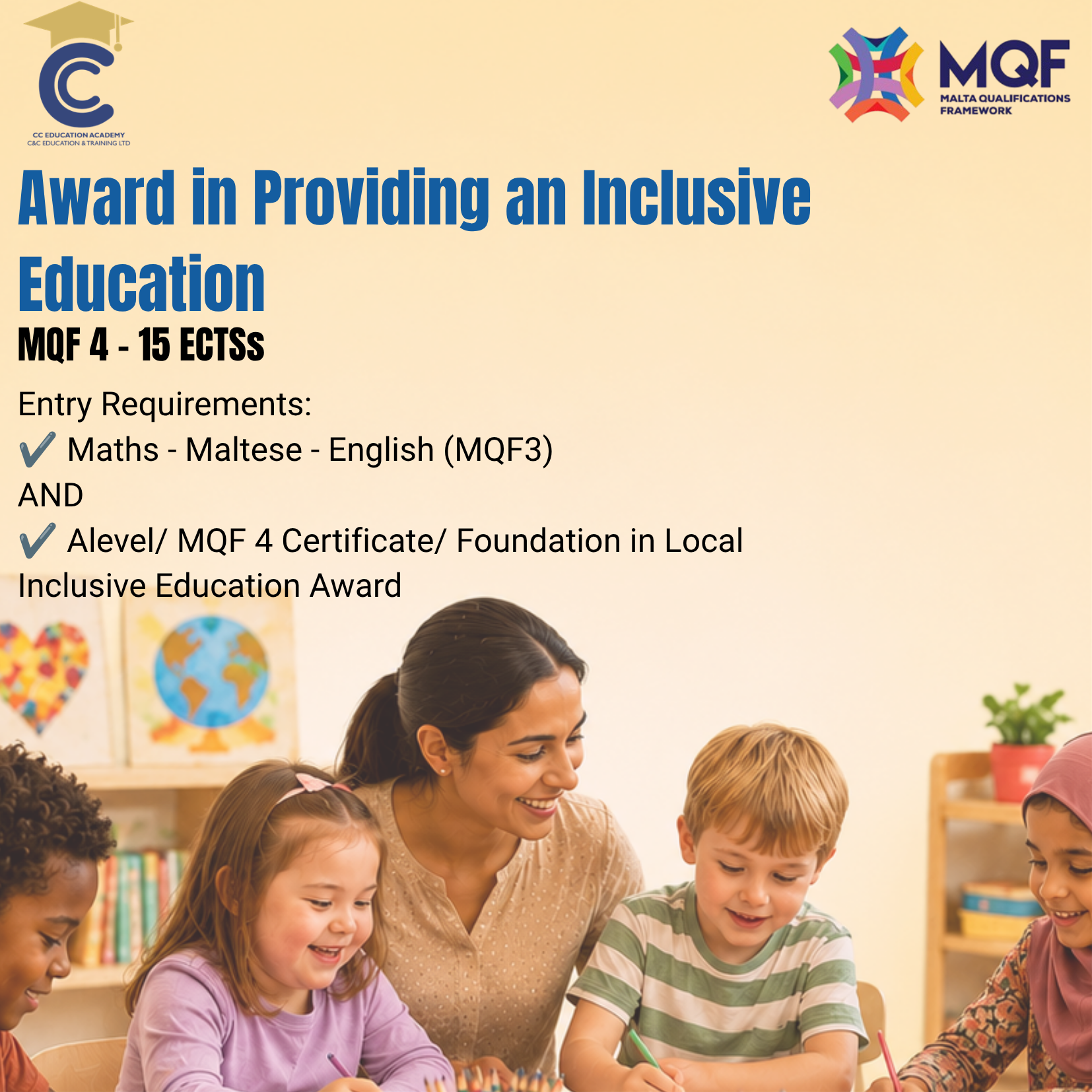
Award in Providing an Inclusive Education - (aka 10 week programme) - SEPTEMBER INTAKE
CC Education Academy
Licensed as a Further and Higher Institution by the MFHEA
Licence no. 2022-019
Course delivery: ONLINE
Placement hours: 110hrs
Course duration: Approximately 13 weeks on a Part-time basis only
Language of delivery: English/ Maltese
Total Hours (which includes self study and assessment hours calculated according to the MFHEA guidelines) 375hrs
Target Audience
This programme targets those individuals who would like to pursue a career within the field of inclusive education and work as a LSE.
Entry requirements
Effective communication in both English and Maltese. Four (4) Matsec Level qualifications that include Maltese, English and Mathematics. The fourth (4th) subject can be an ECDL qualification. A proficiency test equivalent to the MATSEC in English, Maths and Maltese – minimum grade 5 – is also valid.
An Advanced Matriculation Level certificate - MQF level 4, minimum grade E, or equivalent. This can include VET qualification.
OR
Currently working as a Supply Learning Support Assistant (sLSE)/ Teaching Assistant (TA)
Those intending to work as an sLSE will do their placement practice on a voluntarily basis in a school setting.
Note: Exemptions from Maltese will be allowed to English-speaking learners. However, they will need to present another subject at the same level. For these learners, a TOEFL or IELTS certificate in English is also valid. Link to Identy Malta VISA requirements: https://www.identitymalta.com/unit/central-visa unit/
Grading
Learners must achieve a minimum score of 50% in each module to qualify for certification.
Student Success Rate
Up to date (March 2025), a 100% student success rate has been recorded. All students who have pursued this programme to the end have received their certification.
The programme
This course introduces learners into the world of inclusion. It is equivalent to what is commonly known as the 10-week course and is intended for LSEs who would like to start their journey as LSEs. This course is compulsory for those who are already in employment and would like to continue their journey as educators and is the first step to achieving higher level of education in inclusive education. Basic resource-making, IEP and MAP session set up is discussed. Learners also learn about the most common disabilities as well as how to deal with difficulties encountered in the classroom.
Modules
This module serves as an introduction to inclusion. The terms inclusion, integration and segregation are discussed at length. Moreover, the module focuses on children’s rights and our duty as educators to provide a safe space for all students. Barriers to inclusive process are also discussed and practical examples on how to overcome them are presented.
Assessment method: 20% Forum Participation and 80% developing a resource
Module Learning Outcomes
At the end of the module/unit the learner will have acquired the responsibility and autonomy to:
Assess situations where inclusion is/ is not taking place, and act appropriately to ensure an inclusive place for their students
Carry out tasks to remove the barriers for their students
Create a welcoming environment for all students in class
Ensure that they are not creating a barrier themselves and that their practice is in line with the policies
Be responsible for using the LOs as a way of honoring the Inclusive Policy
Define inclusion as opposed to integration/segregation
List the three main barriers of inclusive education
Name the advantages of providing inclusive education
Describe and differentiate between equality, equity, and justice
Recall why inclusion is a right and not a privilege
Identify the educators’ responsibility towards creating an inclusive space
Critically assess situations where learners’ right are not met
Discuss with other team members on how to improve inclusion in class
Research and compare different texts to identify the best ways to put inclusion in practice
Use effective techniques to identify learners’ needs to ensure that they are met in an inclusive environment
Use material and resources developed in class and translate them into child-friendly wording to aid learners understand and relate to the term inclusion
Identify their role in creating an inclusive environment
Identify ways on how to effectively implement inclusive strategies that can help learners with diverse needs
Practice an inclusive attitude at their workplace as well as their private lives
Design and implement methods that will ensure their students have the right attitude towards inclusion
Practice good inclusive strategies in line with the inclusive policy
Plan, design and develop a child-friendly poster using online libraries for research, and relevant PC programs to develop such project
This module focuses on required skills in relation to working within a team and to formally prepare MAP and IEP documentation. This module delves into the importance of creating SMART objectives for the students, as well as how to devise a well worded and relevant IEP/MAP.
Assessment method: 20% Forum Participation and 80% Class-based exercise
Module Learning Outcomes
At the end of the module/unit the learner will have acquired the responsibility and autonomy to:
Carry out effective analysis of learners’ abilities and needs
Ensure effective planning and preparation for MAP and IEP sessions
Be responsible for effective communication in meetings and discuss goals
Create SMART goals that use the student’s abilities to address needs
Recall practical jargon that is used during meetings
List the requirements of MAP and IEP forms
Identify the areas discussed in meetings
Define the different forms of teamwork
Identify the importance of setting SMART goals
Create SMART goals that use the learners’ abilities to address the needs
Address the needs of the learners using the strengths identified
Practice good teamwork and communication skills within the multidisciplinary team
Develop an understanding on the importance of teamwork
Formulate an IEP and MAP based on a case study
This module intends to familiarise the learners with the Learning Outcomes Framework and how this can be utilised to assess the child’s academic level, as well as how the curriculum can be adapted to the child’s needs.
Assessment method: 20% Forum Participation and 80% Project
Module Learning Outcomes
At the end of the module/unit the learner will have acquired the responsibility and autonomy to:
Identify the different areas of development
Create resources and devise strategies to address the areas
Carry out tasks to make sure that the student who is/will be in their care is given a holistic education
Use the LO Framework effectively
Identify the importance and relevance of the LO Framework document
Identify the meaning and importance of the areas of development
List examples of holistic education practices
Devise and implement strategies to address the needs of their learners
Make sure that all development areas are being given importance
Use the LO Framework document to find targets relevant to different developmental areas
Devise strategies that address more than one area of development
Plan and select goals for their students using the LO Framework document
Use digital media effectively to do research
The aim of this module is to serve as an introduction to various disabilities. Assuming that the learners are still new to this field of study this module offers a brief overview of common strengths and challenges that are associated with these different disabilities.
Assessment method: 20% Forum Participation and 80% Assignment
Module Learning Outcomes
At the end of the module/unit the learner will have acquired the responsibility and autonomy to:
Collaborate with class teacher and observe the students in their care
Supervise the students’ development
Create a relevant plan according to the strengths and needs
Identify some traits that may be common in these conditions
Identify developmental areas that may need to be addressed
Show understanding of common misconceptions
Understand the dilemma of the diagnosis being a source of labelling as opposed to being a helpful exercise
Define ways on how to advocate for the students in their care
Distinguish between identity-first and person-first language, and how to tell what language to use in different situations
List the possible traits related to the different disabilities
Identify ways on how one can counteract the effects of labelling
Identify the principal areas of development that will need to be addressed according to the difficulties that may be presented
Discuss how one can offer better support to their learners
Advocate for learners who are facing barriers
Demonstrate understanding on how certain misconceptions have stemmed through the years
Practice good inclusive strategies based on their knowledge on reputable NGO rather than solely rely on information that is often heard
Practice effective research using the internet as a source of information
This module focuses on communication skills and how the learners, as professionals in a school, can apply healthy ways of communication. The module also addresses interpersonal skills as well as intrapersonal abilities. Practical applications of the skills are discussed at length.
Assessment method: 20% Forum Participation and 80% Multiple-choice test
Module Learning Outcomes
At the end of the module/unit the learner will have acquired the responsibility and autonomy to:
Use their communication skills and be more self-aware
Identify different means of communication
Identify ways on how to improve their communication skills
Use different strategies to improve learners’ emotional intelligence
Identify non-verbal cues sent by others as well as by themselves
Collaborate with other professionals using good communication skills
Understand the concept of intrapersonal skills and its importance
Identify the three unique elements of intrapersonal skills – self-concept, perception and expectation
Describe the use of effective communication skills and the different types of communication methods
List ways of improving communication skills
Name ways of using different strategies to improve student’s emotional intelligence
Describe ways of using non-verbal cues sent by others as well as by themselves
Self-reflect on their own communication skills
Use different strategies with children to improve emotional intelligence
Practice healthy ways of communication
This module allows learners to put to practice what the skills, knowledge, and competence that they have acquired at the workplace. Learners are asked to meet the needs and address a set of learning outcomes to demonstrate their ability to work with their students and carry out the tasks required from an effective and successful LSEs.
Assessment method: 40%Visits 40%File 20% Interview
Module Learning Outcomes
At the end of the module/unit the learner will have acquired the responsibility and autonomy to:
Collaborate with superiors and colleagues at the workplace
Carry out tasks provided by workplace successfully
Monitor behaviour of learners and tailor education experience for the requirements and needs of the learners
Attend to the needs of learners in an effective manner
Produce an effective portfolio portraying one’s work
Describe the importance of reporting and journaling throughout the practice placement
Write an effective portfolio including all required material and resources
List the strengths and requirements of the student in their care
Recall the types, causes and characteristics of various disabilities
List the requirements for high quality of inclusive education
Demonstrate ability to implement the methods and techniques learnt throughout the sessions at the workplace
Use knowledge acquired on disabilities to be cater for the needs of the student
Show knowledge on the diverse types of disabilities, and relevant strategies
Analyze their own learning and implement various strategies to accommodate and provide a tailor-made experience to learners in their care
Create resources that cater for their students’ needs
Form attachments with their students to enable a healthy learning environment
Create resources suitable for the child’s age and abilities.
Create activities that show creativity and innovation
Use the LSE toolkit created throughout the previous units
Communicate effectively with the tutors to discuss the placement
Keep track of the child’s progress according to the LO Framework
Create flashcards, power point presentations and worksheets
Design games and interactive activities that will fit in with the child and the topics learned at school
By the end of the programme, learners will be able to:
• Describe the main principles of inclusion and the reasoning behind these principles.
• Describe the role of an LSE.
• Define IEP and MAP and identify the role of IEP and MAP meetings.
• Recall ways to best accommodate learners with diverse needs using evidence-based practices.
• Identify learners’ needs and cater for them accordingly.
• Describe ways in which effective research can be used at the workplace.
• Describe the need for effective communication and team working skills.
• Plan effectively and participate in IEP and MAP meetings.
• Use effective team skills to work with other professionals.
• Use up-to-date research to address the difficulties that their student might be facing.
• Use various communication channels, both verbally and non-verbally, that will ensure teamwork.
• Create healthy communication with their students, regardless of whether such communication is verbal or non-verbal.
• Design resources and implement strategies to put inclusive principles into action.
• Practice a positive attitude in the workplace.
Please note that all payments are non-refundable.
+ €20 registration fee
No online payment required. Bank transfer instructions will be sent after registration.