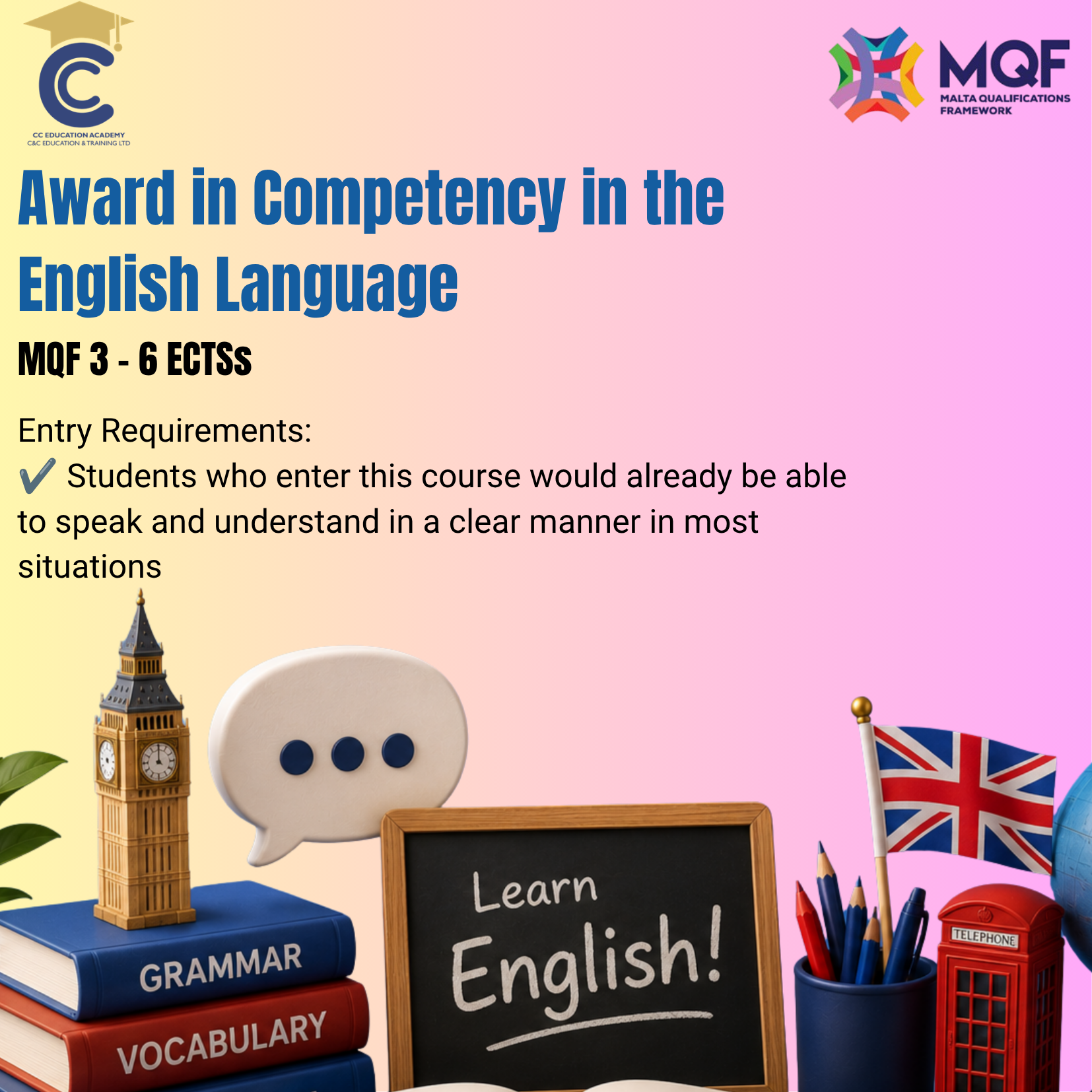
Award in Competency in the English Language
CC Education Academy
Licensed as a Higher Education Institution by the MFHEA
Licence no. 2022-019
Course delivery: ONLINE
Course duration: 12 weeks on a part time basis
Language of Delivery: English
Total Hours (which includes self-study and assessment hours calculated according to the MFHEA guidelines) – 150 hrs
Entry requirements
Students who enter this course would already be able to speak and understand in a clear manner in most situations.
Target Audience
This programme will equip students with the necessary qualifications to apply for an Early Years course and other programmes which ask for MQF3 Proficiency in English.
If the applicant wishes to apply for the LSE course, please note that the qualification per se does not fulfil the requirements of an O’Level, however the programme covers different areas in the syllabus of the myexams.gov.mt exams. Therefore, if the student follows the course he/she will have enough knowledge to acquire a pass in these exams.(/i)
Grading
The Grading will be assessed with a PASS/ FAIL criterion, where if the students gets a pass in every module, he she will be able to acquire the certification.
Student Success Rate
Programme success rate is 100% if excluding an average of 5% dropouts.
The Programme
This course is intended for adults who need an intermediate-level course in the English language. CC Education Academy will be providing Inclusive Education courses to prospective Learning Support Assistants, and this course will be recommended to those students who need more practice in the English language. This course will give them a twice-weekly practice session, in listening, speaking, and writing.
Modules
Each week students are given a different reading task. The task will not only involve reading and understanding but also looking out for things in the text such as attitude and inferences.
Assessment Methods: Live reading, online exercises
Module Learning Outcomes
By the end of the programme, the learner will be able to:
Understand different types of text.
Describe tone and attitude in a piece.
Confidently read aloud to an audience.
Identify phrasal verbs and idioms and understand their importance in giving tone to the text.
Show ability to skim, scan and read for gist.
Paraphrase texts
Draw inferences and conclusions
Consult online dictionaries to search for meanings of new vocabulary and expressions.
Grammar points will be elicited from the texts. These will be practised orally and in online exercises. Emphasis will be made on the functional aspect of the parts of speech taught, their application in writing and in spoken language.
Assessment methods: Grammar Oral exercises and online exercises
Module Learning Outcomes
By the end of the programme, the learner will be able to:
Understand the difference between stative and action verbs.
Understand the correct usage of the past simple and past continuous.
Produce sentences using ‘used to’ and ‘would’.
Carry out grammar tasks where conditionals are used (zero, first, second, third)
Be responsible to use reported speech and reported questions appropriately.
Identify when to use the present simple, present continuous, past perfect simple and continuous, future perfect and modal perfect.
Understand the function of causative verbs.
Understand appropriate usage of quantifiers.
Understand the function of modals in a sentence.
Know the difference between defining and non-defining relative clauses
Practise of both reported speech and reported questions.
Use quantifiers in writing or conversation: e.g., use of both/both of/ each/each of/ every
Use articles appropriately in writing and in speech. Articles
Practice the use of question tags in writing and conversation.
Use time clauses effectively (e.g., until…, when…, before…)
Each week will carry and different theme. Vocabulary and language connected with that theme are tackled and used in writing exercises, oral exercises, and conversation. Students will be encouraged to look up new vocabulary and use idiomatic written and spoken English.
Assessment Methods: Online and oral exercises
Module Learning Outcomes
By the end of the programme, the learner will be able to:
How to form nouns ending in -ity, -ship and -ness.
How to form adjectives by using prefixes and suffixes.
Recognise words that are similar in meaning, but not the same (e.g., involve and include)
Identify synonyms.
How to form new words using -ion and -ment.
Use vocabulary connected with each theme: identity, house and home, travel, the outdoors, health, food and drink, shopping, fashion, sport, entertainment, education, nature
Recall the meaning of idioms and how these can enrich conversation and writing.
Identify nouns associated with people.
Recognise where to use -ing words and infinitives appropriately.
Identify and form common collocations associated with the theme of the week.
How to use phrasal verbs learnt with each theme in writing and conversation.
How to use various verb collocations learnt with each theme (make do, move in)
Use of I wish and if only to talk about hypothetical situations.
How to use result clauses in oral exercises
Students will listen to different clips each week. The purpose of listening exercises is to get students to be mindful of tone, identify contradictions, sift information to extract what is relevant, listen for attitude and opinion. These exercises will help students understand audio clips better and will also help them improve their spoken English.
Assessment Methods: Oral exercises, online games, online exercises
Module Learning Outcomes
By the end of the programme, the learner will be able to:
How to understand a situation from an audio clip
How to identify attitude and opinion from a clip.
How to identify the main idea of each clip.
How to select what information is relevant.
Recognise synonyms in an audio clip.
List words that are similar in meaning
Identify ways of paraphrasing what is heard.
How to sift through information, identifying what is and what is not relevant.
Show what information is contradictory and giving reasons why.
Understanding of implication.
Making logical assumptions from what is heard.
Speaking will take place throughout both lessons, but will given special attention in the second lesson, where 45 minutes are set aside for speaking. There will be a theme every week, and students will be prompted to use the vocabulary and language learnt during the first lesson.
Assessment Methods: Guided discussions and online interactive exercises
Module Learning Outcomes
By the end of the programme, the learner will be able to:
Describe a scene, in a photo or video clip.
Carry out tasks where they have to use adverbs of frequency.
Express opinion
Describe situations and actions
Talk about other people using adjectives of habit and personality.
How to express uncertainty using e.g, It looks like…, I think…
Describe how and when auxiliary verbs are used.
Answer questions about themselves.
Choose what questions to ask in general conversation.
Listen and respond appropriately in a conversation, giving both speaker and listener a balanced amount of time.
Use the phrases, phrasal verbs and idioms learnt in a conversation.
The writing section will consolidate all that is learnt throughout the previous sections. There will be two forms of writing, a thought-piece that is written as a reflection of the reading undertaken in independent study. This will be written in the forum section of the LMS. The second piece will be a different task each week, which will centre around the theme of the week. Students will brainstorm with the teacher; the teacher will help the students outline their plan. Students will be expected to write the task after the lesson.
Assessment Methods: Weekly tasks and Journalling
Module Learning Outcomes
By the end of the programme, the learner will be able to:
Write about oneself.
Describe an activity in writing.
Plan a story.
Plan an email.
Use direct speech in writing.
Express preference.
Elicit the main points of an email, prior to replying.
Match language with type of content.
Recognise narrative tenses and using them in a story.
Use appropriate language to make polite suggestions.
Choose appropriate words to express preference (prefer, rather)
Write an introductory email
Write an invitation
Write a thank-you note
Write a review
Respond to a writing prompt
Create a storyboard
Write down instructions on how to do a chosen task.
Construct the topic sentence and use it to introduce a paragraph
Answer an email.
Learning Outcomes: Knowledge
By the end of this programme, the learners will be able to:
• Understand different types of text.
• Identify phrasal verbs and idioms and understand their importance in written and spoken language.
• Describe tone and attitude in a piece of writing.
• Describe the different states of verbs and their usage.
• Recall the use of modals, relative clauses, and articles.
• Understand conditionals.
• Understand word collocations.
• Recognise adjectives, adverbs, nouns, verbs, and the word patterns connecting these parts of speech.
• Recognise synonyms and words similar in meaning.
• Recall vocabulary connected with each topic.
Learning Outcomes: Skills
By the end of this programme, the learners will be able to:
• Skim, scan, and read for gist.
• Paraphrase texts.
• Draw inferences and conclusions from texts and audio clips.
• Use modals in conversation and writing.
• Apply question tags in conversation.
• Use passive and active voice appropriately.
• Practice writing emails.
• Choose style according to type of writing.
• Express opinions, give reasons, and make suggestions in written and spoken language.
• Write instructions, descriptions, and narratives.
• Discern between relevant and irrelevant information in text or audio clips.
Please note that all payments are non-refundable.
+ €20 registration fee
No online payment required. Bank transfer instructions will be sent after registration.